
Dear all – first and foremost: we wish you a happy 2024! May this new year be more peaceful, caring and much kinder to everyone, human and nonhuman.
It is our great pleasure to invite you all to the upcoming Eco- and Bioart Lab event – the webinar on “Deep Futures, Radioactivity, and the Arts” with our speakers and presenters: artist and doctoral researcher Erich Berger (Oulu University, FI) and postdoc Dr Thomas Keating (Linköping University, SE).
The webinar takes place on 18th January 2024 at 13:15 – 15:00 CET on Zoom.
With this event we also launch a series of spring webinars LITHIC ECOLOGIES focused on the thematic of the lithic and the arts. Thus, in case questions of geology, earthly matter(s), their temporalities, aesthetics and ethico-politics are dear to you, do make sure to stay tuned!
Participation is free of charge, but you need to REGISTER for the webinar by following the link: https://bit.ly/R4d1O4c
Below you may find more information about the presentations and our speakers.
“Deep Futures, Radioactivity, and the Arts”: The Eco- and Bioart Lab Webinar
18th January 2024, 13:15-15:00 CET on Zoom.
The event is conceptualised as a space of dialogue anchored in two presentations:
Of Landscape Machines and Spectral Landscapes
Abstract:
In my fieldwork-based artistic research practice, I extensively work in landscapes with heightened natural and anthropogenic radioactivity, potential uranium mining sites, nuclear infrastructure, and nuclear heritage sites in Finland and abroad. How to live with the nuclear in the present and what will the future inherit from us? These questions are the central vantage point of my artistic practice concerned with the nuclear Anthropocene. Nuclear heritage is an example of anthropogenic deep future impact. It is now that we draw the temporalities that future human generations and other entities must embrace. As we implicate ourselves intentionally or inadvertently with processes which outlive us as individuals, we could also equip ourselves with the necessary tools and languages to understand their consequences. In my presentation, I will introduce my artistic work and raise the question of how art can assist in fostering an imagination that connects the present with deep more-than-human futures.
Bio:
Erich Berger is a doctoral researcher, artist and curator based in Helsinki. He works at the University of Oulu in Finland, where he conducts transdisciplinary research into how artists approach temporalities beyond human-centred time, intersecting cultural anthropology with art and geology. His current artistic focus lies on issues of deep time and hybrid ecology which led him to work with geological processes, radiogenic phenomena and their socio-political implications in the here and now. Websites:
https://www.oulu.fi/en/researchers/erich-berger
Speculative techniques: Nuclear waste burial and the management of deep earth futures
Abstract:
The development of ‘permanent’ or ‘final’ repositories for nuclear waste Sweden and Finland relies on a set of technological, aesthetic, and temporal logics for managing the distant future – conceptualised here as the speculative techniques of nuclear memory communication. Whilst integral to the way these nuclear waste burial sites are constructed and managed by experts, these logics are sometimes difficult to detect and applied indirectly by experts without explicit recognition. Drawing on my current research with Prof Anna Storm writing a Key Information File for a nuclear waste repository that must last 100,000 years, I set out some avenues for investigating these speculative techniques. Understanding and identifying these techniques is potentially fruitful, I argue, because they are integral to the way deep earth futures are rendered ‘manageable’ in formal practices of permanent nuclear waste storage.
Bio:
Dr Thomas Keating is a postdoctoral researcher at Linköping University, SE. Keating’s work intersects cultural geography and process philosophies, and engages with problems involving human-technology relationships. He has recently published on nuclear memory (Progress in Environmental Geography), techno-genesis (Progress in Human Geography), geophilosophies (Subjectivity), speculative empiricism (Theory, Culture & Society), and Speculative Geographies (Palgrave Macmillan). He is currently writing a document for the Swedish Nuclear Waste Management Company (SKB) for their nuclear waste repository to last 100,00 years – see: https://nuclearmemory.wordpress.com/. Contact: thomas.keating[at]liu.se
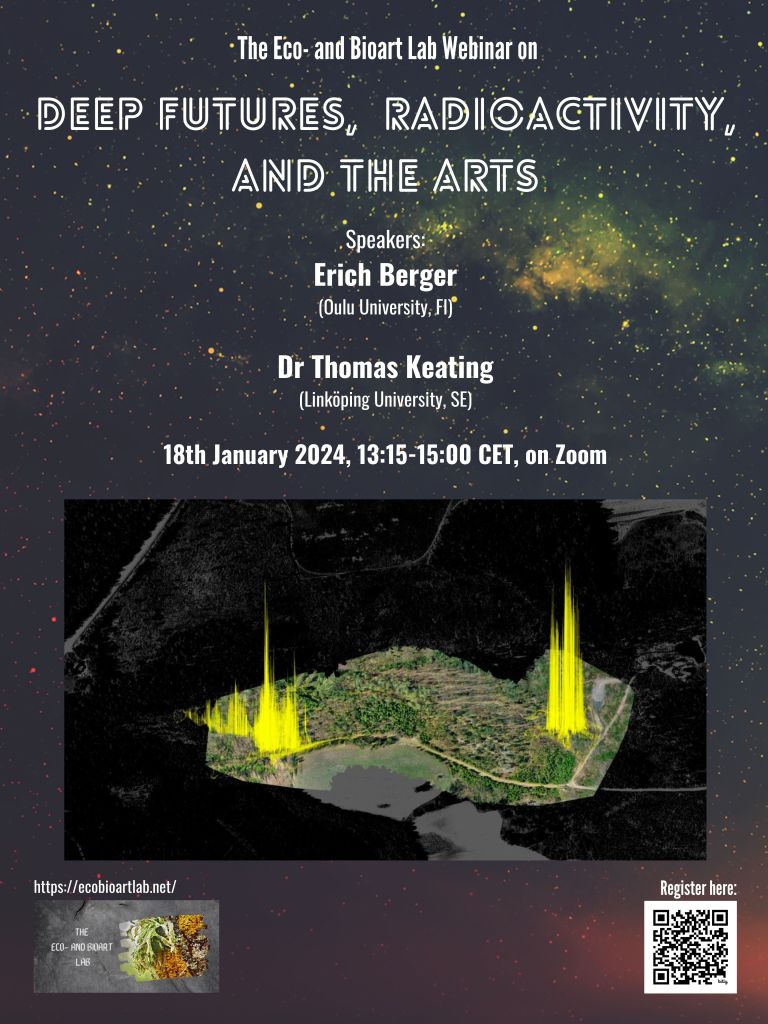
Image included on the poster: Kovela – Rare Earth Element Deposit, gamma radiation intensity distribution, Erich Berger 2020
REGISTER HERE: https://bit.ly/R4d1O4c
The seminar forms part of the LITHIC ECOLOGIES event series, organised as part of the ECO-GRIEF research project, funded by FORMAS: A Swedish Research Council for Sustainable Development.

 The Eco- and Bioart Lab
One response to ““Deep Futures, Radioactivity, and the Arts”: The Eco- and Bioart Lab Webinar with Erich Berger (Oulu University, FI) and Dr Thomas Keating (Linköping University, SE), 18 January on Zoom.”
[…] case you missed our exciting event: “Deep Futures, Radioactivity, and the Arts” with: artist and doctoral researcher Erich Berger (Oulu University, FI) and postdoc Dr Thomas […]
LikeLike