
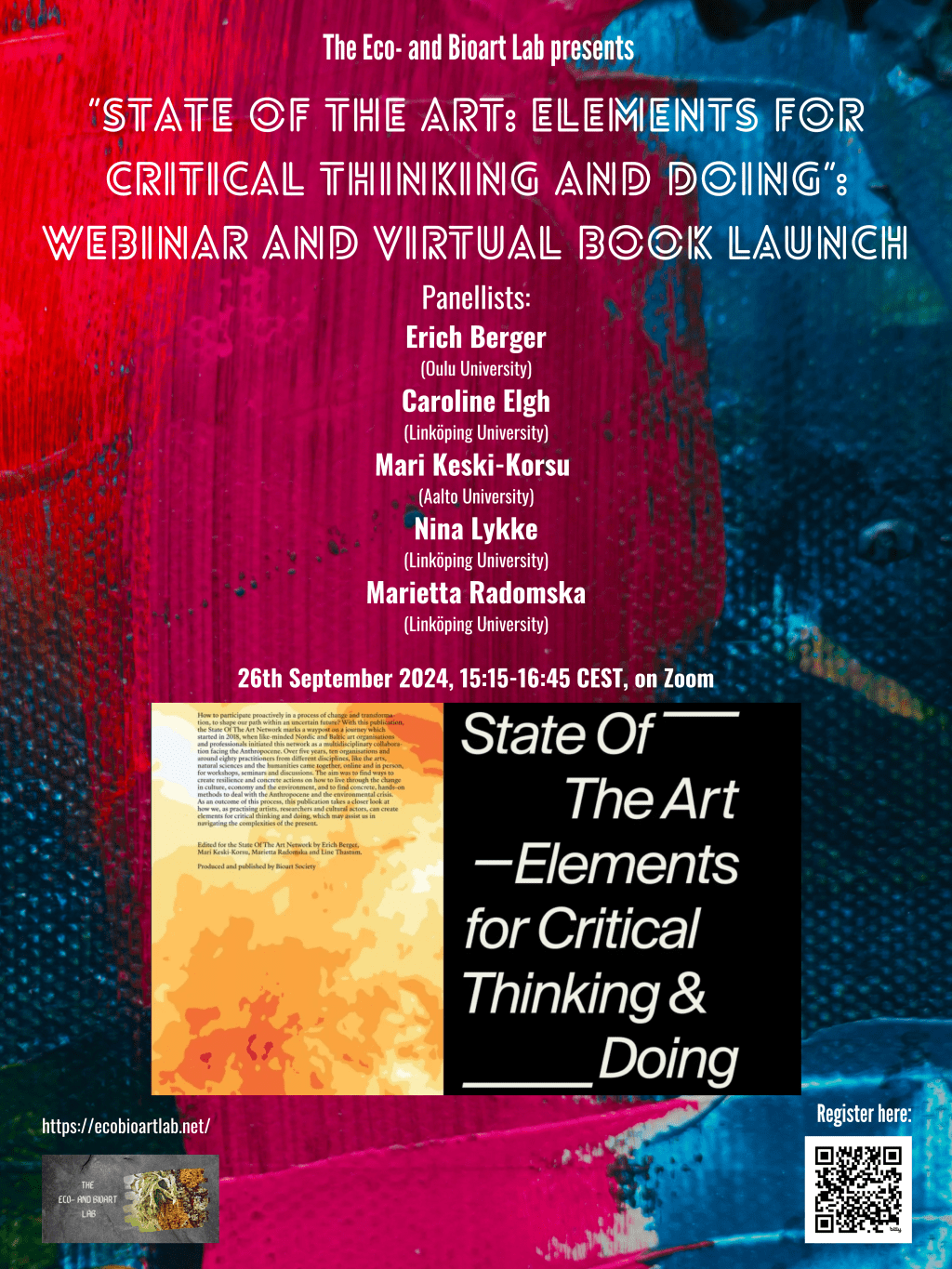
Welcome to “State of the Art: Elements for Critical Thinking and Doing”: The Eco- and Bioart Lab Webinar and Virtual Book Launch, which takes place on 26th September 2024 at 15:15-16:45 CEST on Zoom.
On 26th September 2024, we – as both members of the editorial team and the contributors – gather for the discussion and virtual launch of the book State of the Art: Elements for Critical Thinking and Doing, edited by Erich Berger, Mari Keski-Korsu, Marietta Radomska, and Line Thastum. The book came out in 2023, and was published by Bioart Society.
While the edited collection had its first physical launch last year in Helsinki, FI, with this virtual discussion panel and book launch, we wish to zoom in on critical-creative potentials, specific powers, and role of art, artistic practices, artistic research, and art-activism in the context of more-than-human planetary crises. We will also reflect on various dimensions, possibilities, and challenges of transdisciplinary collaborations, which are so urgently needed in the here and now.
For more on the project and the book, see below.
Register HERE: https://bit.ly/4etyK6y
Panellists:
Erich Berger (Oulu University, FI)
Caroline Elgh (Linköping University, SE)
Mari Keski-Korsu (Aalto University, FI)
Nina Lykke (Linköping University, SE)
Marietta Radomska (Linköping University, SE)
About the panel / launch and the publication:
The publication wraps up the State of the Art Network (SOTAN) collaboration project. SOTAN has been a Nordic-Baltic transdisciplinary network of artists, practitioners, researchers, and organisations who have come together to discuss the role, responsibility, and potential of art and culture in the Anthropocene. By developing creative practices, transdisciplinary collaborations and public engagement, SOTAN has aimed to create resilience and concrete actions on how to live through the change in culture, economy and the environment and to find concrete, hands-on methods to deal with the Anthropocene and the environmental crisis.
With this publication, we want to take a closer look at how we as practising artists, researchers and cultural actors can create elements for critical thinking and doing which can assist us in navigating the complexities of the present. The publication is organised into four sections: 1) Understand Unfold Recognise, 2) Listening Introspection Immersion, 3) Translate, Communicate, Collaborate and 4) Reacting Acting Change. It is important to see these sections, not as strict compartments where the different contributions land in a definitive slot but more, as a guide through the rich material produced by the collaboration. The contributions range from the arts and curatorial practices to activism, humanities and economy, interspersed with recaps of activities organised by collaborating SOTAN entities during the last three years and other related material in the form of images, poetry or maps.
State of the Art Network has been supported by Nordic Culture Point, Nordic Culture Fund, and A. P. Møller Foundation.
The book is available in OPEN ACCESS and can be downloaded HERE.
Panellist bio notes:
Erich Berger is an artist, curator and cultural worker based in Helsinki and a doctoral researcher at Oulu University. His research in Cultural Anthropology concerns how art can approach temporality beyond human-centred time scales. Throughout his artistic practice, he has explored the materiality of information and information and technology as artistic material. His interest in issues of deep time and hybrid ecology led him to work with geological processes, radiogenic phenomena and their socio-political implications in the here and now.
Caroline Elgh is an art curator, writer, educator, and PhD researcher in Gender Studies at Linköping University. She forms part of the Eco- and BioArt Lab research team and is also Co-Director of the Posthumanities Hub. With background in cultural studies her work within the fields of feminist environmental humanities, blue humanities and posthumanities explores postdisciplinary processes at the intersection of art, science, political ecology and speculative fiction. Previously as a curator at Bonniers Konsthall in Stockholm she curated exhibitions and publications such as Cosmological Arrows that examined contemporary art’s relation to science fiction, ecology and technology.
Mari Keski-Korsu is a post-disciplinary researcher and artist whose work focuses on multispecies collaborations. The medium of expression is a hybrid combination of participatory performance, visual and live art. Her practice involves intuitive interspecies communication, hydrobodily care in folk healing and walking methodologies to acknowledge relationality in sentient ecologies. She is a doctoral researcher (expected 2024) in Aalto University. Her research focuses on more-than-human ritualisations in change in the (sub)Arctic and especially the microbial life of permafrost.
Nina Lykke, Professor Emerita, Gender Studies, Linköping University, Sweden, and Aarhus University, Denmark, is a queerfemme-inist philosopher-poet. Current research: queer death studies, intersectionality, feminist posthumanism, queerfemme theory, queer ecologies, poetic writing. Author of numerous articles, edited volumes and monographs such as Cosmodolphins (2000), Feminist Studies (2010), Vibrant Death (2022 ) and Feminist Reconfigurings of Alien Encounters (2024, with K.Aglert and L.Henrksen).
Marietta Radomska, PhD, Docent, is Associate Professor of Environmental Humanities at Linköping University; director of The Eco- and Bioart Lab; co-founder of Queer Death Studies Network; co-editor of the book series ‘Focus on More-than-human Humanities’ at Routledge (with C. Åsberg). She works at the intersection of environmental humanities, continental philosophy, queer death studies, visual culture, contemporary art, and artistic research; and has published in Australian Feminist Studies; Somatechnics; Environment and Planning E, and Artnodes, among others.

The seminar forms part of the CRISIS IMAGINARIES AND ECOLOGIES event series, organised as part of the ECO-GRIEF research project, funded by FORMAS: A Swedish Research Council for Sustainable Development.
 The Eco- and Bioart Lab