
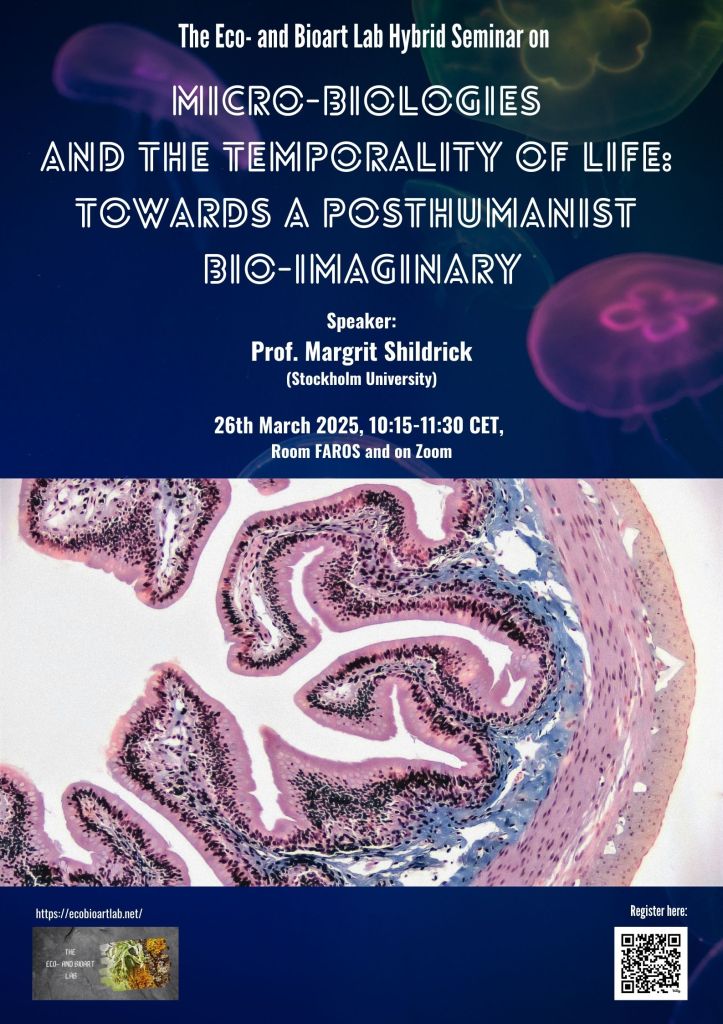
Warm welcome to The Eco- and Bioart Lab Hybrid Seminar with Prof. Margrit Shildrick (Stockholm University) on “Micro-biologies and the Temporality of Life: Towards a Posthumanist Bio-imaginary”.
The event takes place on 26th March at 10:15-11:30 CET in the room Faros, Tema building, Campus Valla, Linköping, and on Zoom.
Please, register HERE: https://bit.ly/3FhkKkd
Micro-biologies and the Temporality of Life: Towards a Posthumanist Bio-imaginary
Abstract:
My presentation picks up some of the themes of my last book Visceral Prostheses and shows how the emergent biologies of the microbiome and microchimerism underpin a contestation of some of the most entrenched binaries of Western-generated Modernism: life and death; human and animal; male and female; and above all self and other. On a theoretical and material level, belief in the singularity of human life becomes unsustainable. Once the unlimited material manifestations of life are recognised, and that all forms of existence are intra-active at levels beyond regular control, then there are no grounds for privileged distinctions between one living entity and another. In the bio-imaginary the possibilities of transformation are not a choice but simply the ecology of life, whether human or otherwise.
Bio:
Margrit Shildrick is Guest Professor of Gender and Knowledge Production at Stockholm University and works mainly in the field of biophilosophy. Her projects include an extensive multidiscipilnary study of the phenomenological experience of heart transplantation; an ongoing collaboration with Queer Death Studies; excursions into bioart and its posthumanist implications; and rethinking the concept of the gift as more than human and far far more than exchange. Books include Embodying the Monster: Encounters with the Vulnerable Self (2002), Dangerous Discourses: Subjectivity, Sexuality and Disability (2009), and Visceral Prostheses: Somatechnics and Posthuman Embodiment (2023). Most recent article: ‘Posthumanism, ethics and the entanglements of disabled embodiment’, Minority Report (2025) 18.
The seminar forms part of the CRITICAL ECOLOGIES event series, organised as part of the ECO-GRIEF research project, funded by FORMAS: A Swedish Research Council for Sustainable Development.
 The Eco- and Bioart Lab