
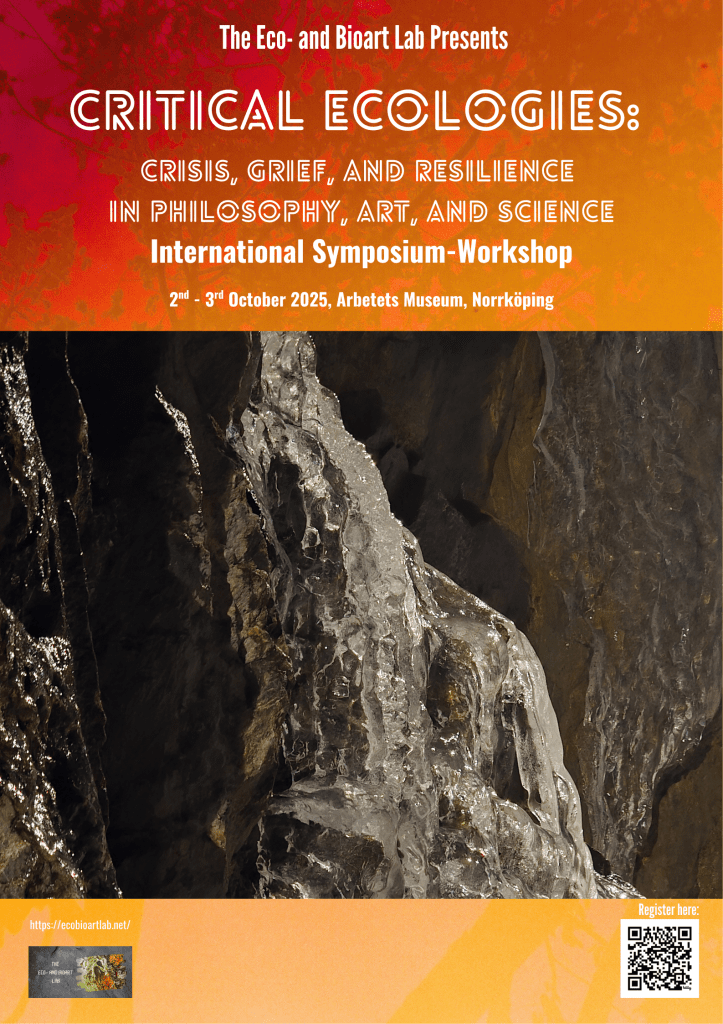
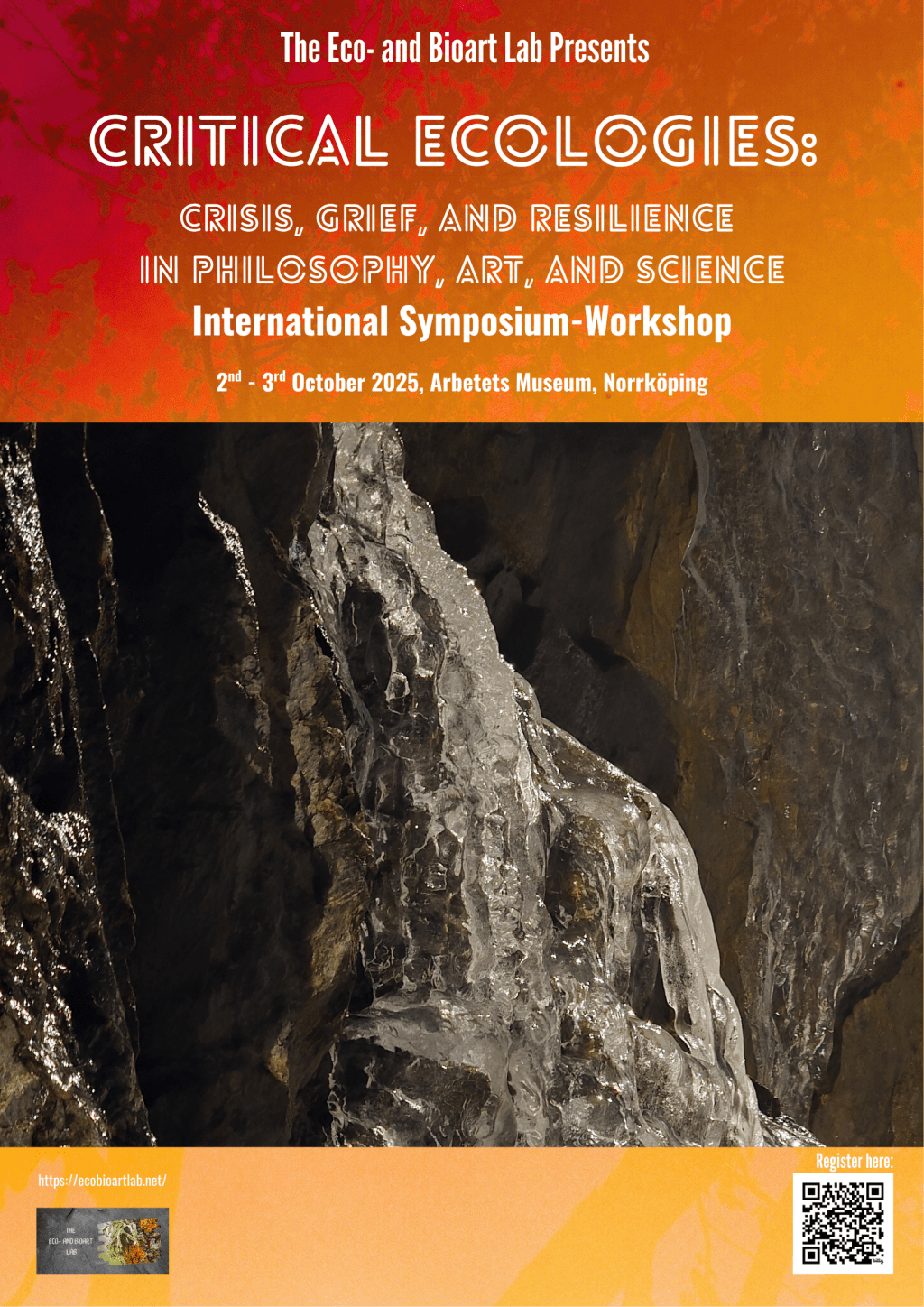
Dear all – we finally have a pleasure to open the registration for the International Symposium-Workshop “Critical Ecologies: Crisis, Grief, and Resilience in Philosophy, Art, and Science”, hosted by The Eco- and Bioart Lab, Linköping University. The event takes place on 2nd – 3rd October 2025 (it starts at 13:00 CEST on the 2nd, and ends at 14:00 CEST on the 3rd) at Arbetets Museum in Norrköping.
The symposium is organised on location ONLY. It will however be documented via video and photos.
We have a limited number of seats and therefore we kindly ask you to register only if you are planning to attend the symposium IN PERSON.
You can find the registration link at the bottom of this page.
The detailed schedule and full programme will be published soon.
The Eco- and Bioart Lab International Symposium-Workshop: “Critical Ecologies: Crisis, Grief, and Resilience in Philosophy, Art, and Science”
2nd-3rd October 2025, Arbetets Museum, Norrköping
Presently, climate change, species extinction and loss of biodiversity, destruction of habitats and ecosystems, epidemics, and slow environmental violence are converging with wars, extractivisms, renewed imperialisms, inequalities, and (neo)colonialisms. The biological and the technological, the natural and the social, the environmental and the ethico-political are tightly intertwined.
We find ourselves in the midst of critical ecologies.
With global warming unfolding in the Arctic four times faster than in the rest of the planet and the Baltic Sea turning into the largest ‘dead zone’ in the world, environmental disruption is acutely present in the social and cultural awareness close to home.
The sense of multiple crises, uncertainty, and more-than-human vulnerabilities evoke feelings of anxiety, despair, anger and grief, manifested both globally and locally in culture, scientific and popular-scientific narratives, environmental activism, and art.
Simultaneously, dominant societal discourses tend to prioritise either the techno-fix solutionism (the ‘technology-will-save-us’ scenario) or the all-encompassing apocalyptic framing (‘we are doomed’).
We need conceptual tools that would allow us to make sense of the converging more-than-human crises and their accompanying imaginaries and narratives; a toolbox that would assist us in resisting the binary of ‘techno-optimism vs impeding doom’; and last, but not least, an apparatus that would enable us to respond to the complex conditions of the present.
The EBL International Symposium-Workshop Critical Ecologies: Crisis, Grief, and Resilience in Philosophy, Science, and Art brings together researchers from across the humanities, social and natural sciences, and science studies, artists and artistic researchers, designers, curators and cultural workers, as well as other practitioners, in order to engage in a transversal, inter- and transdisciplinary dialogue on the social and cultural understandings of, engagements with, and responses to the critical conditions of the present.
The symposium-workshop is organised as part of the research project Ecological Grief, Crisis Imaginaries and Resilience in Nordic Lights (2022-26), funded by FORMAS: A Swedish Research Council for Sustainable Development.
Keynote Speakers:
Prof. Dick Kasperowski (University of Gothenburg, SE)
Dr Margherita Pevere (Independent Artist and Researcher, IT/DE)
Prof. Madina Tlostanova (Linköping University, SE)
Keynote Respondents:
Prof. Cecilia Åsberg (Linköping University, SE)
Prof. Margrit Shildrick (Stockholm University, SE)
Dr Marietta Radomska (Linköping University, SE)
Speakers:
Dr Flora Mary Bartlett (Linköping University, SE) and Prof. Lotten Gustafsson Reinius (Stockholm University/Nordiska Museet, SE)
Erich Berger (University of Oulu)
Pernilla Fagerlönn (Independent Artist, SE) and Dr Karin Reisinger (University of Applied Arts / Academy of Fina Arts Vienna, AT)
Bartira S. Fortes (Södertörn University, SE)
Dr Janne Halme (Aalto University, FI)
Prof. Andrew Meirion Jones (Stockholm University, SE) and Dr Hannah Kate Sackett (Bath School of Art, Film and Media, UK)
Dr Björn Kröger (University of Helsinki, FI)
Dr Gloria Lauterbach (Aalto University, FI)
Prof. Em. Nina Lykke (Linköping University, SE/Aarhus University, DK)
Dr Ayşem Mert (Stockholm University, SE) and Dr Katharina Glaab (NMBU, NO)
Dr Mirko Nikolic (Södertörn University, SE)
David Revés (NOVA University Lisbon, PT)
Dr Natalia Volvach (Stockholm University, SE)
Rut Karin Zettergren (Uniarts Helsinki, FI)
The event starts at 13:00 on 2nd October and finishes at 14:00 on 3rd October.
Keynote Lectures:
More-than-Human Rights to Procreate: Legal Agency in Hybrid Landscapes
By Prof. Dick Kasperowski (University of Gothenburg, SE)
This presentation explores more-than-human rights to procreate within the context of environmental law, specifically examining how species’ procreation is legally framed and protected in hybrid landscapes. The research focuses on Swedish environmental legal practices, where citizen science—particularly the Swedish Species Observation System (Artportalen)—is instrumental in gathering species data that influences court decisions. Through a posthuman lens, the paper challenges traditional anthropocentric legal frameworks, exploring the recognition of species’ right to procreate as fundamental to their survival and biodiversity conservation. The talk highlights an evolving role of environmental courts, particularly the Swedish Land and Environment Court of Appeal, in integrating citizen-reported species observations into legal processes. By analysing a series of court decisions from 2012 to 2024, the talk illustrates how legal agency is assembled around species’ procreation through multispecies relationships, temporal and spatial considerations, and the socio-ecological networks that enable reproductive success. The results show that, while the legal system remains rooted in human-centered frameworks, there are instances where ecological and relational approaches are shaping new legal understandings, providing a more inclusive, sustainable form of governance for biodiversity in the Anthropocene.
Bio: Dick Kasperowski is professor of theory of science at the University of Gothenburg. Informed by contemporary posthuman perspectives in science and technology studies (STS), his primary interests lie in the governance of science, citizen science, the unintended consequences and misuse of technical infrastructures for biodiversity reporting, and the management of uncertainty in public scientific controversies. His research focuses on how political and scientific representations are made agential and how more-than-human citizenship is connected to research policy and scientific practices. Specifically, he explores how rights and obligations toward science and research are attributed and appropriated by different actors in conflict zones, and the various modes of governance this entails.
Lamenting for the More-than-Human
By Dr Margherita Pevere (Independent Artist and Researcher, IT/DE)
Expressing grief and mourning for others is present in cultural practices and arts with rich and diverse traditions across times and cultures. Yet, this compassionate gesture has mostly contemplated ‘human’ ruins. The status of engulfing tragedy has been reserved for hero(in)es and loved ones but mostly skewed around that which is not human. Today, the unsettling disruption of ecologies brings along the need to attune and care for the dead with a revisited understanding: lamenting can no longer be human-only.
Interweaving death and ecologies, wildfires belong to many regions around the globe. Their patters or ‘regimes’ have shaped whole ecosystems, organisms physiology, and species behaviour. Wildfires have also historically instigated both stewardship and friction between human communities and lands. Currently, wildfire regimes are changing due to interplay of factors like climate fracture, eco-disruption, or changed agricultural and land management practices. The interplay of these global and local factors is rather complex. While fire management practices are today quite advanced, in vulnerable ecosystems wildfires may result in extreme events that devastate the land and its inhabitants with long-lasting effects.
The installation and performance Lament (2024) reflects on changing wildfire regimes to seek for new attunements with death and wounded ecologies. Its realisation included fieldwork in wildfire-affected areas, transdiciplinary collaborations, community engagement and biotechnological experimentation. The artwork reacts to eco-disruption with reluctance and urgency. The first is the reluctance to accept environmental damage as unavoidable. To simply accept it, together with its implicit injustice, would mean give up hope and generative practices in troubled times. The urgency is linked with the role of artists and intellectuals in society: to contribute to a vocabulary for changes yet to come. Art and research can offer a safe space to articulate things for which the right words do not yet exist.
Bio: Known internationally for her otherworldly artworks with living matter, ecology and biotechnology, Dr Margherita Pevere is an artist and researcher addressing taboos like death, sex and vulnerability. Her work ‘Lament’ on wildfire ecologies was awarded the COAL Prize Transformative territories mention (2024) and she was nominated for the Falling Walls Awards Category Art and Science (2023) for the body of work around her concept ‘arts of vulnerability’. Her work extends beyond the arts through collaborations across science and society. Among the projects she co-initiated there are the exhibition Membranes Out Of Order and the performance duo Fronte Vacuo.
https://orcid.org/0000-0002-8853-5768
Between Abandonment and Adaptation, or Learning from a Dandelion
By Prof. Madina Tlostanova (Linköping University, SE)
Today it is no longer enough to say that the world is in crisis as it is quickly turning from a transitory uncertain state into a world that the decision-making accelerating elites have already abandoned. This refers to dispensable lives, human and other, and to the planet. Their acceleration is no longer about progress or happy future, but rather about bringing the end of the world closer and completing the modern/colonial cycle of alienation from the world and the creation of an artificial environment for the chosen transhumans. The vast and diverse abandoned world in the accelerators` design differs within itself only by the degree and speed of its abandonment. But the real difference between the already abandoned and those who for a while are distracted with populist slogans, xenophobia or nationalism, is a matter of time and more importantly, a matter of awareness and political and ethical choice, of the position one selects – that of the doomed victim or a calm stoic who, knowing that victory is impossible, nevertheless tries to prolong the struggle and the existence of life on the planet.
In his latest book Tony Fry (Fry 2025) refers to those who consciously opt for the paradigm of adaptation ”the world of retention” meaning that they will try to preserve in the coming decades what can still be saved in the world that is disappearing before our eyes. It is not only about endangered species or reservoirs of clean water, but also about the disappearing fabrics of human and interspecies relations, about solidarity and empathy or the “biology of love” (Maturana and Verden-Zoller 2008) as a feature of our species, which once helped us survive and which we are rapidly losing. The adaptation mode can also become a new reactive mechanism in the evolutionary sense, enabling us to adapt to emerging conditions. The world of retention is the world of people who soberly realize and accept that “adaptation is a normative social and economic practice of coping and care” (Fry 2025, p. XXV) and the only thing we can oppose to deadly acceleration. In my view of the future, a timid hope lies precisely in such islands of adapters or interspecies communities of neo-endemic survival, necessarily local, often indigenous, relearning how to сonsciously exist in a dynamic and complex relation to the world and committed to the idea of caring for it.
Fry, T. 2025. Political Breakout. Situation, Need, Action. Vernon Press.
Maturana, H, and G. Verden-Zoller. 2008. The Origin of Humanness in the Biology of Love. Pille Bunnel.
Bio: Madina Tlostanova is a feminist thinker and fiction writer, professor of postcolonial feminisms at Linköping University. Her research interests include decoloniality,the postsocialist human condition, fiction, and art; critical future inquiries and critical interventions into complexity, crisis, and change. Tlostanova`s most recent books include A new Political Imagination, Making the Case (co-authored with Tony Fry, Routledge, 2020), Decoloniality of Knowledge, Being and Sensing (Centre of Contemporary Culture Tselinny, Kazakhstan, 2020, Kazakhian translation – 2023), and Narratives of Unsettlement. Being Out-of-joint as a Generative Human Condition (Routledge, 2023). Currently she is working on a book on the stateless future.
REGISTRATION: https://bit.ly/4lISM1d . Please note that this event has reached the maximum number of registered participants. If you would like to take part, please, email us at: ecobioartlab@liu.se, so that we may be able to add your name to the waiting list – in case of cancellations, we’ll be able to make extra seats available.
SYMPOSIUM PROGRAMME as a PDF file.
 The Eco- and Bioart Lab