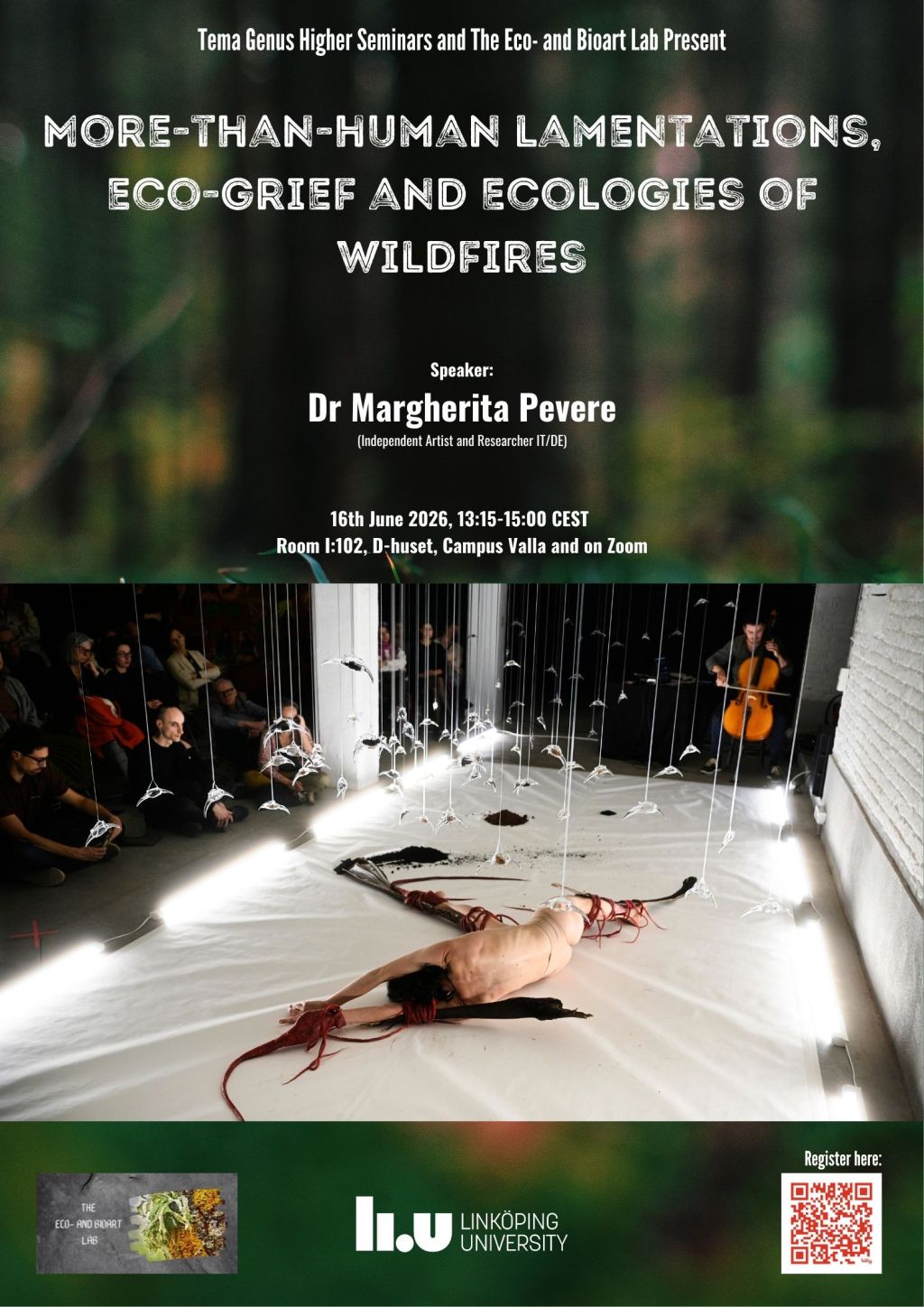
With great pleasure we invite you to join us for the Tema G Higher Seminar with Dr Margherita Pevere (Independent Artist and Researcher DE/IT) on “More-than-human lamentations, eco-grief, and ecologies of wildfires”.
The event takes place on 16th June at 13:15-15:00 CEST in the room I:102, D building, Campus Valla Linköping, and on Zoom.
For Zoom participation, please register: https://bit.ly/4duympM
Dr Pevere is an affiliated member of The Eco- and Bioart Lab and a visiting researcher at Tema G/EBL in week 25.
The Tema G Higher Seminar is preceded by an event with Dr Pevere in the series of The Eco- and Bioart Lab Seminars – also on 16th June at 10:15-11:45. Read more HERE.
The event is organised in collaboration with The Eco- and Bioart Lab, and is included in the programme of artistic research activities within Forma LiU, a joint strategic initiative by the Faculties of Educational Sciences, Arts and Sciences, and Science and Engineering. Forma LiU aims to strengthen creative, design, and aesthetic activities at Linköping University and support new interdisciplinary collaborations across the university. The initiative is run on behalf of the faculties by Stefan Holmlid, Karin Bertills, Konstantin Economou, Anna Ingemark, Andreas Eklöf, Linda Lattik Ekvall, Renee Wever, Alessandra di Pisa, Paul Resch and Marietta Radomska.
More-than-human lamentations, eco-grief, and ecologies of wildfires
Abstract:
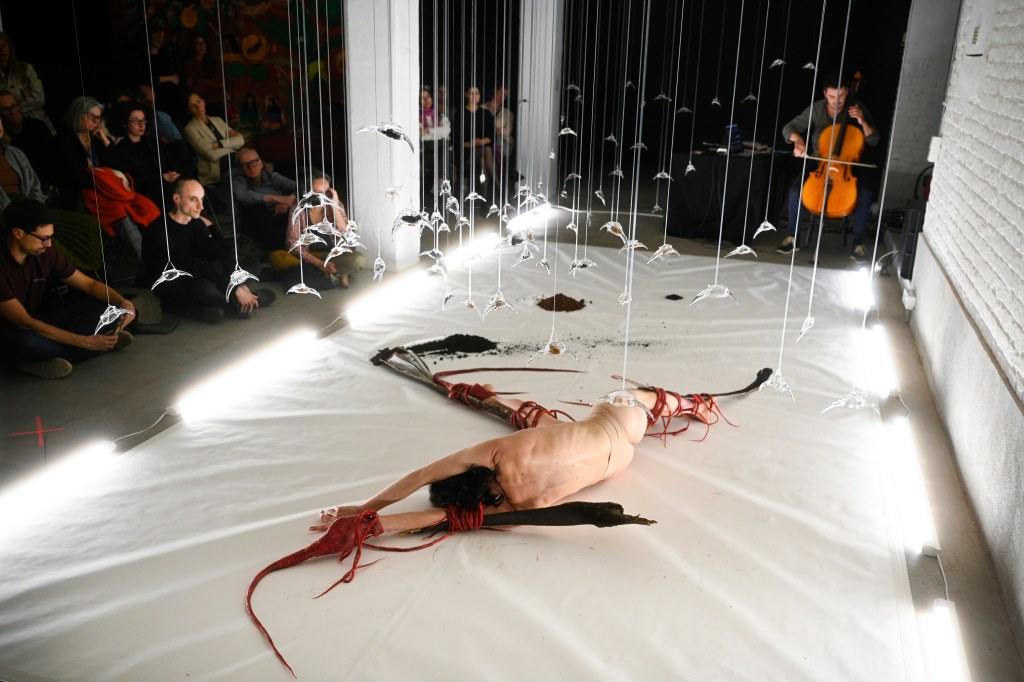
Forms of expressing grief and mourning for others are present in cultural practices, music, visual or performing arts, with rich and diverse traditions across times and cultures. Yet, these compassionate gestures have usually contemplated ‘human’ ruins. Today, environmental disruption has shaped the need to attune and care for the dead with a revisited understanding: lamenting can no longer be human-only. The installation and performance Lament (2024) reflects on wildfires to seek for new attunements with death and wounded ecologies. The artwork attends to the world-making role of wildfires to reflect on their dramatic anthropogenic changes of the last decades. Its realisation included fieldwork in wildfire-affected areas, transdisciplinary collaborations, community engagement and biotechnological experimentation. The artwork reacts to eco-disruption with reluctance and urgency. The first is the reluctance to accept environmental damage as unavoidable. To simply accept it, together with its implicit injustice, would mean giving up hope and generative practices in troubled times. The second is linked with the role of artists and intellectuals in society: to contribute to a vocabulary for changes yet to come. Art and research can offer a safe space to articulate things for which the right words do not yet exist.
Bio:
Known internationally for her otherworldly work with living matter, ecology and biotechnology, Margherita Pevere is an artist and researcher addressing taboos like death, sex and vulnerability. Her practice embraces object-making, installation, performance, and writing, which she waves seamlessly thanks to her transdisciplinary background. Her project Lament on wildfire ecologies was awarded the COAL Prize / Transformative territories mention (2024) and she was nominated for the Falling Walls Awards / Category Art and Science (2023) for the body of work around her concept ‘arts of vulnerability’. Her doctorate in artistic research (Aalto University) focused on bioart and queer and feminist studies.