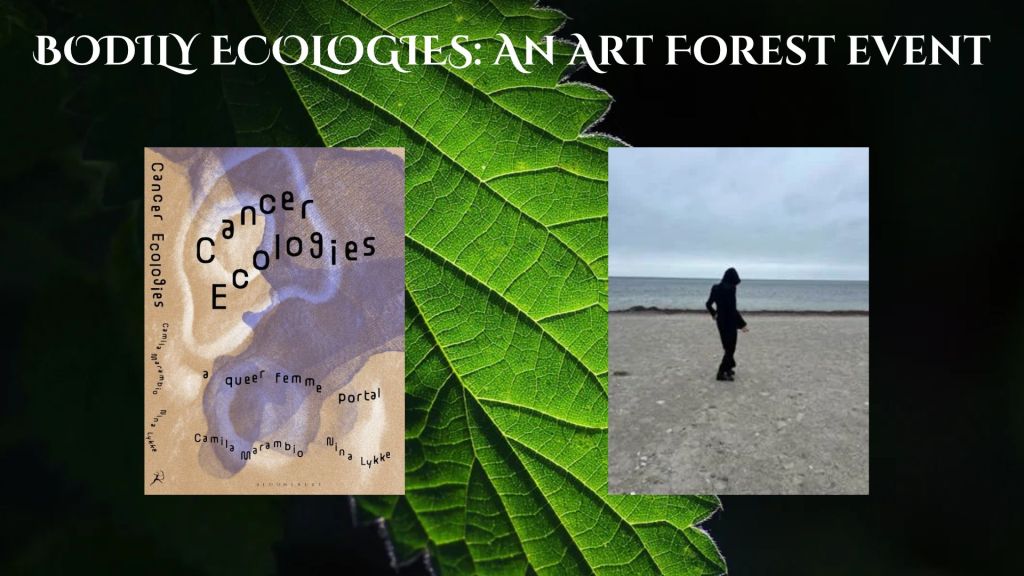
It is our great pleasure to invite you to the event organised by our colleagues at Art Forest, Södertörn University: BODILY ECOLOGIES – An Art Forest event, taking place on 13th November at 13:00-16:00 CET at Södertörn University, Primus, PC249.
Please, note that the number of seats is highly limited and the registration is required.
REGISTRATION: SIGN UP no later than November 10 by sending an e-mail to artforest@sh.se .
Invited speakers:
Nina Lykke, Cancer as Talent or Symptom of a Planetary Body in Ecological Distress
Emma Kihl, Feral Writings
More about the lectures:
Nina Lykke
Cancer as Talent or Symptom of a Planetary Body in Ecological Distress
With a starting point in the folktale style prologue to my new philosophic-poetic book Cancer Ecologies: A Queer Femme Portal (Bloomsbury, London 2026), co-authored with curator and eco-artivist Camila Marambio, the paper will reflect upon the current global, more-than-human cancer epidemic. I will critically comment on the epistemologies of ignorance of public cancer discourses, which cast the disease as a result of genetic heritage or ’bad’ modern life styles such as smoking. Instead, I will read the human and more-than-human spreading of cancer today as a symptom of the Anthropocene necropolitics, which also cause the climate and biodiversity crises, and throw the planet body into distress. Moreover, I will present the queer femme-inist and critically posthumanist ethics of affirmation in which the book’s twinned autophenomenographies of a former cancer patient and a person whose beloved life partner died from cancer, are embedded. I will discuss how I and my co-author came to rethink cancer as a queer femme portal – through Black feminist sci-fi writer Octavia Butler’s provocative, but also utopian image of cancer as talent in her novel Dawn (1987).
Nina Lykke, poet-researcher, emerita-professor, Gender Studies, Linköping University, Sweden, and CUHRE, Elite Centre for the Understanding of Human Relations with the Environment, University of Southern, Denmark. Current research interests: posthuman phenomenology of mourning, queer death studies, cancer ecologies, poetic posthumanities. Most recent monographs: Vibrant Death (2022), Feminist Reconfigurings of Alien Encounters (2024), Cancer Ecologies: A Queer Femme Portal (2026); and co-editor of Routledge International Handbook of Queer Death Studies (2026).
Emma Kihl
Feral Writings
In my doctoral dissertation, Adventurous Achievements: A Reading of Agneta Enckell’s Poems with Isabelle Stengers’ Cosmopolitics (Ellerströms, 2023), I explored Isabelle Stengers’s cosmopolitics as a method of literary analysis. Her cosmopolitical proposal calls for a slowing down of thought and a resistance to the temptation to decide too quickly what a situation is and who or what matters within it. It asks us to attend to the objections that other practices may raise and to the obligations these objections place on our own inquiries. More recently, I have returned to the American poet Lyn Hejinian and her explorations of the continuous present. Her understanding of improvisation challenges the tendency to organise experience into a coherent narrative, in which what happens derives its meaning from what precedes and follows it. Improvisation involves a particular kind of risk: the deliberate undertaking of doubt and the possibility of beginning again without knowing what the next beginning will make of what has already been written. By bringing Hejinian and Stengers together, I want to explore what it means to write in a thick present, where histories are still making themselves felt. I am interested in how the work of feral composition might follow these histories as they take unexpected turns, without arranging them into a single narrative of what has happened and what is yet to come.
Emma Kihl, holds a PhD in Comparative Literature (2023) and an MFA in Fine Art. She is a writer, researcher and senior lecturer at the Royal Institute of Art in Stockholm, Sweden. Her work moves between literary studies, artistic research and experimental writing and reading practices, with a particular interest in cosmopolitics, feminist and speculative methodologies, and environmental humanities.
The event is organised in collaboration with The Eco- and Bioart Lab and Queer Death Studies Network.